
Post
Construction Time-Lapse Planning in the UAE: Capture Progress Without Losing the Story
A construction project may take months, yet the film explaining it may last less than a minute. The challenge is not simply to speed up footage. It is to preserve a consistent view, capture meaningful milestones and deliver a sequence that viewers can understand. Construction time-lapse planning in the UAE starts before a camera is installed, because a poor position or an unreliable capture routine can leave gaps that editing cannot repair.
This guide is for developers, contractors, fit-out companies and production teams commissioning a progress film. It addresses capture planning rather than drone operations or a general corporate event video. The Dubai, Abu Dhabi and Sharjah examples below are hypothetical planning scenarios, not claims about completed Infiniti client projects.
Decide what the film must explain
Start with the intended audience and use. An internal progress review needs different evidence from a short film on a contractor’s website. A developer may want to show a building taking shape, while a fit-out company may need to explain the transformation of an interior. Define the story before choosing equipment, otherwise a technically successful sequence may show little of commercial interest.
Write down the major visible changes: groundwork, structural work, enclosure, interior installation or final handover. Identify which changes can be seen from a single position and which require a separate shot. A fixed camera cannot show detailed workmanship hidden behind a wall. Complementary photographs or short milestone footage should fill those gaps rather than pretending the time-lapse documents everything.
Choose a position that survives the project
Frame the future site, not only today’s activity
A position with an attractive view today may be blocked by the building next month. Review the planned height, site access routes and likely movement of cranes or temporary structures with the site team. Allow room for the completed subject and avoid a frame dominated by equipment that will remain in front of the camera throughout construction.
For a hypothetical warehouse project in Dubai, an elevated position might reveal structural progress better than a ground-level view near the gate. For an interior fit-out in Abu Dhabi, a protected corner may show the room transformation, but a later partition could obstruct it. The production brief should record these risks and name the person who will notify the crew before site changes affect the view.
Make installation a coordinated site activity
Agree installation access, mounting approval, cable routes and maintenance arrangements with the responsible site team. The camera must not obstruct operations or create a hazard. Requirements depend on the property and project; confirm applicable permissions rather than assuming that a marketing brief authorizes every location. Drone filming, if commissioned separately, needs its own operational and permission review.
Build the capture interval around visible change
Time-lapse joins individual images into a moving sequence. The interval between captures determines how much real time is compressed. Nikon’s time-lapse guidance explains interval-based capture. There is no single interval suitable for every construction project: a brief installation task and a months-long structural build have different movement and storage demands.
Use a simple planning calculation. A 30-second sequence at 25 frames per second requires 750 final frames. If a camera captures once every ten minutes for an illustrative eight-hour working window, it produces about 48 images a day, depending on the exact schedule. That calculation helps estimate raw material; it does not guarantee that every frame will be usable or that a continuous sequence will tell the complete story.
Plan around active hours and milestone duration. If a significant operation happens between scheduled captures, the final edit may miss its defining moment. For fast tasks, a separate supervised sequence may be more useful than changing the long-term camera’s routine. Confirm the test results and storage assumptions before committing to the full installation.
Test stability, exposure and file recovery
Record a trial sequence from the proposed position and review it as video, not just as still photographs. Look for camera movement, changing brightness, focus shifts and obstructions. Exposure choices depend on the duration and lighting conditions; a controlled interior sequence presents different challenges from a site moving between daylight and dusk. Have the camera operator select and test settings rather than prescribing one universal configuration.
Check how the system stores files, what happens after power interruption and how missing captures are detected. Name the person responsible for reviewing a sample of recent images. A device showing a power light is not proof that it is saving usable photographs. Confirm that the files can be retrieved and opened before relying on the equipment for an important milestone.
Plan maintenance for heat, dust and access restrictions
UAE projects can expose equipment to demanding outdoor conditions. Select protection according to the manufacturer’s limits and the actual installation environment, including heat, dust and moisture. A housing is only part of the solution: review ventilation, lens cleanliness, mounting stability and safe access for inspection. Avoid placing equipment where maintenance depends on an unsafe or rarely available route.
Create an inspection routine tied to the project. After a dusty period or a nearby site change, check the view and lens before assuming the next sequence will be clear. Keep a record of inspection dates and issues. The aim is to find gaps while there is still an opportunity to correct the capture process, not to discover them when the final film is due.
Capture milestone context alongside the fixed view
A time-lapse becomes easier to understand when the audience knows what changed. Maintain a dated milestone log and collect approved details from the project team. Record the start and end of major phases, camera interruptions and significant changes to the site. Editors can then connect the visible sequence to an accurate timeline without inventing captions from appearance alone.
Supplement the fixed view with purposeful detail shots. A fit-out company could show material installation, finishing and the completed room using matching viewpoints. Keep those shots consistent with the agreed narrative and visual identity. Our corporate photography brief offers a related planning approach for defining how still images will be used across business channels.
Commission the edit and deliverables before capture begins
Specify intended formats, approximate duration and where the film will appear. A wide project film and a vertical social edit need different framing. If the subject cannot survive a vertical crop, plan an alternative composition rather than promising that one camera position will fit every screen. Titles should remain legible on mobile and avoid covering the change that the sequence is meant to show.
Agree who approves captions, project names, logos and completion claims. Do not label a phase complete merely because it appears visually finished. Keep music licensing and any third-party material within the production scope. If an Arabic and English version is required, budget review time for each; video localization planning explains why a second-language version needs more than a last-minute text replacement.
Turn progress into a useful business asset
The best brief connects capture decisions to a real communication task. Request a sample sequence, an installation plan, a maintenance owner and a delivery specification before approving long-term recording. Infiniti in Media brings production and digital delivery together. Explore our film, photography and development services or contact the team with your site, timeline and intended audience to scope a practical progress film.
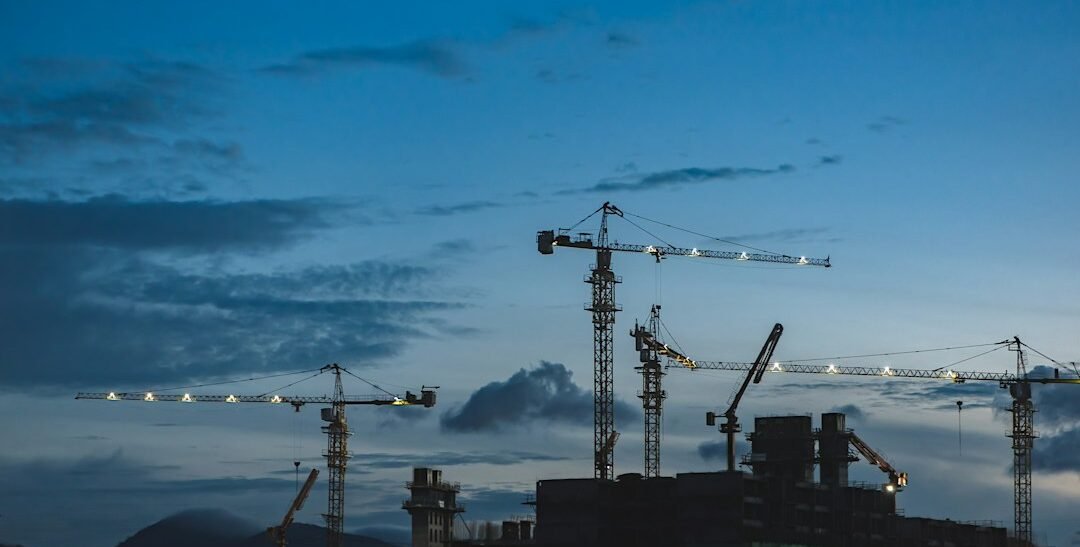
Illustrative photograph: construction cranes and buildings by EJ Yao on Unsplash; not a photograph of a project described in this article.